
Practise ESOL Entry 1 speaking questions about yourself, your class and everyday life. Ask a question, listen to the answer and ask one more question. Start with the examples below, then use your own information. These are original practice activities, not official exam questions.
Start a short conversation
Work with a partner. Choose one question from each group below. Take turns asking and answering. You can look at the examples first. Then cover them and try again.
You do not need to copy an answer exactly. Change the name, place or activity so that it makes sense for you. For classroom practice, you can also invent a character. You do not need to share private details.
New to this level? Read our ESOL Entry 1 skills and practice guide.
Questions about yourself, your class and everyday plans
Introduce yourself
| Question | Two possible answers | Ask one more question |
|---|---|---|
| What's your name? | I'm Amina. / My name's Sam. | How do you spell it? |
| Where do you live? | I live in Leeds. / I live near the college. | Do you like it there? |
| What languages do you speak? | I speak Arabic. / I speak Polish and some English. | Do you practise English at home? |
| What do you like doing? | I like cooking. / I like walking. | Do you do that every day? |
Use a town or general area when you answer “Where do you live?” You do not need to give your full address.
Talk about your class
| Question | Two possible answers | Ask one more question |
|---|---|---|
| What day is your English class? | It's on Monday. / I study on Tuesdays. | What time does it start? |
| How do you get to class? | I take the bus. / I walk. | Do you live near the college? |
| Have you got a pen? | Yes, I have. / No, sorry. | Can I borrow it, please? |
| What do you practise in class? | We practise speaking. / We read short messages. | Do you like that? |
The follow-up question depends on the answer. If your partner says they have not got a pen, ask someone else to lend you one.
Make a simple plan
| Question | Two possible answers | Ask one more question |
|---|---|---|
| Are you free on Saturday? | Yes, I am. / No, I'm busy. | What time can we meet? / Are you free on Sunday? |
| Where shall we meet? | At the library. / At the café. | What time? |
| What time shall we meet? | At ten o'clock. / At half past two. | Is that OK for you? |
| Would you like a tea or a coffee? | A tea, please. / A coffee, please. | Would you like milk? |
Try this task: agree on one place, one day and one time with your partner. Say the plan again at the end so that you both understand it.
Ask, answer and ask a follow-up question
Here are two original sample conversations. The names and details are examples. Practise both roles, then change the information.
Conversation 1: meeting someone in class
Amina: Hello. I'm Amina. What's your name?
Sam: Hi, I'm Sam.
Amina: How do you spell it?
Sam: S–A–M. Do you live near the college?
Amina: Yes, I do. I walk to class. How do you get here?
Sam: I take the bus.
Now try: use different names and a different way to travel. Listen before you choose your next question.
Conversation 2: making a plan
Sam: Are you free on Saturday?
Amina: Yes, I am.
Sam: Shall we meet at the library?
Amina: Yes. What time?
Sam: At ten o'clock.
Amina: Sorry, can you say that again, please?
Sam: Ten o'clock.
Amina: OK. Saturday, at ten, at the library.
Now try: change the place and time. If you are busy, suggest a different day. For example: “I'm busy on Saturday. Are you free on Sunday?”
Picture questions for speaking practice
Look at each picture together. One person asks the questions. The other answers. Then swap roles. The replies below are examples; another clear answer may also work.
Picture 1: at the library

Original AI-generated picture prompt. Use it for the questions and role play below.
- Where are they? In a library. / They're in a library.
- What has the woman got? A book. / She's got a book.
- What colour is the bag on the chair? Blue. / It's blue.
Role play: you want to sit down. Ask, “Can I sit here, please?” Your partner can say, “Yes. I'll move my bag,” or “Sorry, someone is sitting here.” These are imagined replies for practice; the picture does not tell us who owns the bag or whether the seat is free.
Picture 2: in the park
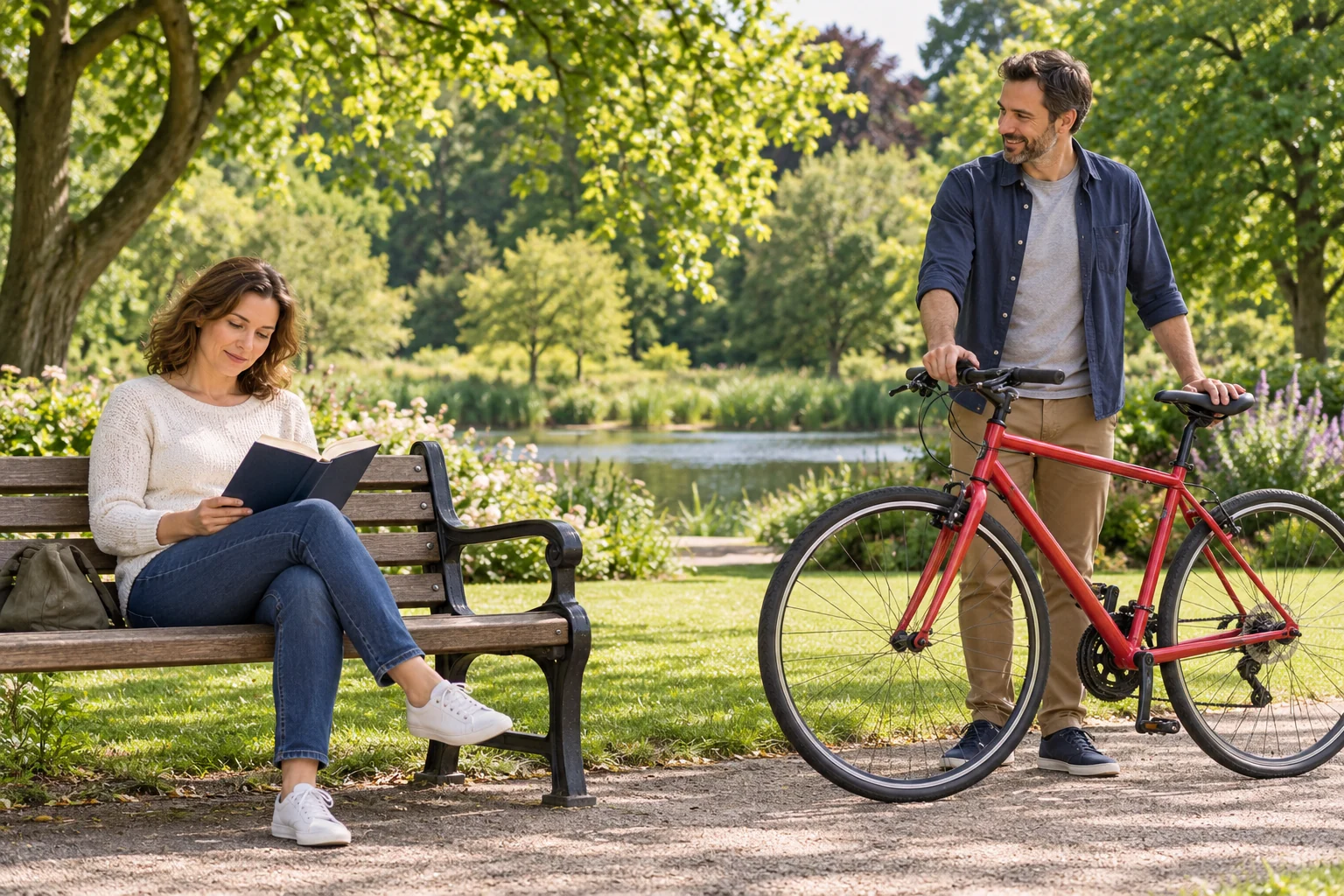
Original AI-generated picture prompt.
- Where is the woman? In a park. / She's on a bench.
- What is she doing? Reading. / She's reading a book.
- What colour is the bicycle? Red. / It's red.
Talk about yourself: do you like reading? Do you like cycling? Ask your partner one question about something they like doing. Your answer does not have to match the people in the picture.
Check whether your meaning is clear
After a conversation, ask your partner to check these points:
- Could I understand your answer?
- Did your answer match the question?
- Did we both have a turn to speak?
- Did you ask a question as well as answer one?
- If something was unclear, did we check it?
Choose one thing to improve. Try the conversation again. This is a practice checklist, not an official exam mark scheme.
Useful phrases when you need help:
- “Sorry, can you say that again, please?”
- “Can you speak more slowly, please?”
- “How do you spell that?”
- “Do you mean Tuesday?”
You do not need to understand every word immediately. Practise asking for the information you need.
Practise alone or use the printable cards
If you are practising alone, choose three questions. Say each answer aloud. If you want, record yourself on your phone and listen again. Check: did you answer the question? Can you hear your words clearly? Change one detail and answer again.
When a partner is available, practise listening and responding to their answers too.
Open the printable speaking cards. Print them from your browser, or use them on screen. The cards include new situations and prompts rather than a script to memorise.
Use the same day-and-time language in our appointment listening practice. For a different skill, try reading tasks with answer evidence when the texts suit your learning needs; these are not equivalent level assessments.
Preparing for a particular ESOL exam
These activities help you practise everyday conversation. They do not describe every task in an Entry 1 speaking and listening assessment.
Ask your tutor which awarding organisation provides your qualification. Use that organisation's current specification and sample materials for your assessment date:
- Trinity College London: Entry 1 speaking and listening resources.
- English Speaking Board: Entry 1 resources.
- Gateway Qualifications: ESOL Entry Level 1.
Trinity's resources page also includes changes labelled for September 2027. Check which guidance applies to your assessment date.
For more original tasks across different skills, try our ESOL assessment practice tasks. If you are unsure which level to practise, read ESOL levels explained.
Frequently asked questions
Are these official ESOL Entry 1 speaking questions?
No. Nolixia created these questions, conversations and picture activities for practice. Use your awarding organisation's materials for official examples and assessment requirements.
Can I give a different answer?
Yes. Use an answer that fits the question and the situation. For “How do you get to class?”, you might say “I take the bus”, “I walk” or another answer that is true for you.
How can I practise if I do not have a partner?
Say your answers aloud, change the details and ask yourself a follow-up question. Use the pictures to describe what you can see. Later, practise with another person so that you also respond to answers you have not prepared.