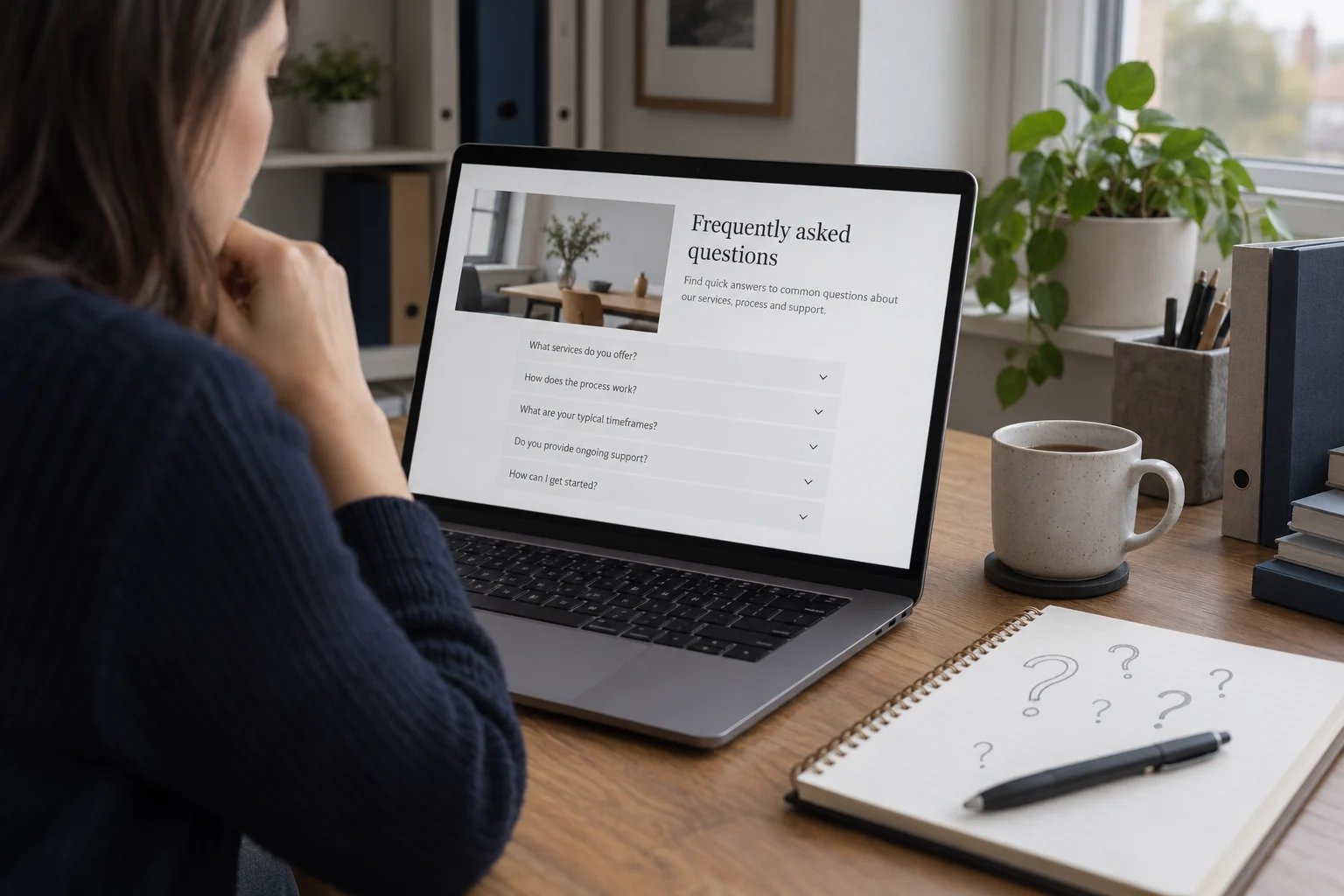
Useful website FAQs answer the questions that stop a customer from deciding or taking the next step. FAQ schema is a way to describe question-and-answer content in structured data, but it should not be confused with an automatic search ranking benefit or a promise of extra space in Google results.
As of this article's review in October 2026, Google no longer displays the FAQ rich result feature. Google recorded its discontinuation from 7 May 2026 and removed the associated documentation in June. Older articles recommending FAQ markup specifically to win that appearance should be read with this change in mind.
The Google Search documentation changelog: https://developers.google.com/search/updates records the change. The practical reason to write FAQs remains helping customers understand your service.
Start with real decision questions
Review recent enquiries, sales conversations and information staff repeatedly explain. Group the questions by the page where the answer becomes useful. A kitchen consultation page might explain what measurements to bring. A maintenance page might distinguish a content update from a new feature.
Avoid adding a long collection of generic questions to every page. A visitor inspecting installation services needs relevant information about installation, not repeated introductory paragraphs about the entire business.
Put the main answer in the main content
If most visitors need an answer, make it easy to find in the normal page structure. Important service coverage, ordering instructions or contact routes should not be hidden in a collapsed section solely to keep the first screen visually tidy.
Use FAQs for supporting questions that remain after the main explanation. For example, a service description can explain the process, while a nearby question answers whether the customer needs to supply photographs before an initial discussion.
Write an answer that helps someone act
A useful answer explains a condition or next step. Compare an unclear answer such as "We offer complete solutions" with a specific instruction to send the website address, describe the problem and identify who currently manages hosting.
Do not promise outcomes the business cannot control. If a completion date depends on supplied content, explain that dependency. If a feature requires an existing account or suitable platform, say so. This builds a more usable page than repeating reassuring language without information.
Link to the detailed explanation
Keep the answer understandable on its own, then offer a relevant next page where needed. A question about choosing a provider can link to the Birmingham web design company checklist: https://nolixia.com/blog/how-to-compare-web-design-companies-in-birmingham. A question about post-launch checks can link to the website maintenance checklist: https://nolixia.com/blog/a-practical-website-maintenance-checklist-for-uk-businesses.
Links should help the reader continue the task. They do not need to repeat the same commercial keyword in every answer. For a broader content structure, see our website content writing guide: https://nolixia.com/blog/website-content-writing-a-practical-business-page-plan.
Treat structured data as an accurate description
When structured data is used, it should describe content that exists on the page. It should not invent answers, company credentials or customer results. A technically valid schema document does not guarantee that a search engine will show a particular result treatment.
Because the Google FAQ rich result feature has been discontinued, adding FAQPage markup is not a sensible substitute for improving the visible content. If a developer keeps it for another documented use, ask which consumer needs it and how it will stay consistent with the page.
Review FAQs when the service changes
Assign someone to review questions when policies, delivery arrangements or service scope changes. Remove contradictions between the FAQ and the main content. A short accurate answer is more valuable than an extensive archive of old information.
Check that an accordion, if used, works with a keyboard and clearly identifies the expanded answer. Test the page on a phone as well as a desktop.
Measure usefulness rather than markup alone
Ask whether enquiries are arriving with the necessary information and whether customers still need clarification of the same issue. Search Console can show which queries lead people to the page, but it cannot establish by itself that FAQ markup caused a change in results.
Use the questions to strengthen the relevant Birmingham web design service page: https://nolixia.com/web-design-birmingham, keeping technical implementation in proportion to the benefit for customers.